

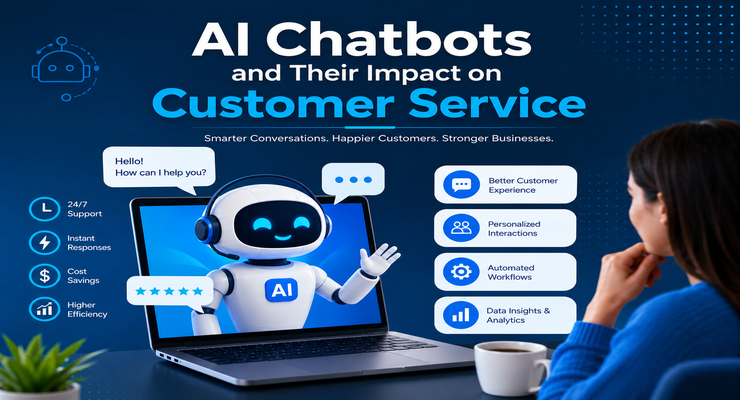
Customer service has changed dramatically in the last decade. Customers no longer want to wait on long calls, send emails that take days to receive a response, or navigate complicated support systems. Today, people expect instant answers, personalized experiences, and round-the-clock support. This shift in customer expectations has created a huge opportunity for businesses to adopt artificial intelligence (AI) chatbots.
AI chatbots are transforming how companies interact with customers. From answering simple questions to solving complex problems, chatbots are becoming an essential part of modern customer service strategies. Whether you are shopping online, booking a flight, subscribing to software, or contacting technical support, there is a high chance that you have already interacted with an AI-powered chatbot.
But how exactly are AI chatbots impacting customer service? Are they replacing human agents or simply helping them become more efficient? Let us explore.
What Are AI Chatbots?
AI chatbots are software applications designed to simulate conversations with humans using text or voice. Unlike traditional chat systems that follow predefined scripts, AI-powered chatbots use technologies such as Natural Language Processing (NLP) and machine learning to understand customer intent, answer questions, and improve over time.
For example, if a customer asks:
“Where is my order?”
A traditional chatbot may only respond if the wording exactly matches predefined rules. An AI chatbot, however, can understand variations like:
- “Track my package”
- “Has my order shipped?”
- “When will I receive my delivery?”
This makes customer interactions smoother and more human-like.
The Growing Importance of AI Chatbots in Customer Service
Customer service teams often deal with thousands of repetitive questions every day. Customers ask about pricing, refunds, order tracking, account issues, subscriptions, passwords, and product details.
Handling all these requests manually can be expensive and time-consuming. This is where AI chatbots make a major difference.
They automate repetitive tasks, reduce waiting times, and improve customer satisfaction while allowing support teams to focus on more important and complex issues.
Let us look at the major ways AI chatbots are impacting customer service.
1. Faster Response Times
One of the biggest advantages of AI chatbots is speed.
Customers hate waiting. Research consistently shows that long waiting times negatively affect customer experience and brand trust. AI chatbots solve this problem by responding instantly.
Instead of waiting several minutes for a support representative, customers receive immediate answers to their questions.
For example, an e-commerce company can use a chatbot to instantly answer questions related to:
- Shipping timelines
- Return policies
- Payment issues
- Product availability
This immediate support improves customer satisfaction and reduces frustration.
2. 24/7 Customer Support
Unlike human agents, AI chatbots never sleep.
Businesses traditionally depend on working hours, support shifts, and availability of employees. However, customers may need help at any time of the day.
AI chatbots provide continuous support 24 hours a day, seven days a week.
Imagine a SaaS company with global customers. A customer in another country may face login issues during midnight business hours. Instead of waiting until morning, they can immediately interact with a chatbot to troubleshoot the issue or raise a support ticket.
This creates a better customer experience and improves trust in the business.
3. Reduced Customer Service Costs
Hiring and maintaining large customer support teams can be expensive.
AI chatbots help businesses reduce operational costs by automating repetitive customer interactions.
For example, if a support team receives 10,000 queries every month and 60% are repetitive, a chatbot can handle most of these interactions automatically.
This reduces:
- Customer support costs
- Ticket volume
- Employee workload
- Response delays
Instead of replacing employees completely, companies often use chatbots to support human teams more effectively.
Human agents can then focus on difficult or sensitive customer issues that require emotional understanding or advanced problem-solving.
4. Personalized Customer Experience
Modern customers expect personalization.
AI chatbots can analyze customer history, behavior, preferences, and previous interactions to provide tailored responses.
For example, if a user frequently browses SaaS development services on a marketplace website, the chatbot may recommend:
“Looking for SaaS product development? Here are agencies that match your budget and requirements.”
Similarly, streaming platforms and online retailers use AI systems to recommend products or services based on previous activity.
This personalization improves engagement, customer satisfaction, and conversion rates.
5. Better Scalability During High Traffic
Human customer service teams can only manage a limited number of interactions at one time.
During sales events, product launches, or marketing campaigns, businesses often struggle to handle spikes in customer demand.
AI chatbots solve this issue by managing thousands of customer interactions simultaneously.
For example, during a festive sale, an online shopping platform may receive a massive increase in customer questions regarding orders, discounts, payment failures, or shipping.
Instead of making customers wait, AI chatbots can instantly assist everyone at scale.
This ensures a smoother customer experience during peak periods.
6. Improved Data Collection and Customer Insights
Every customer interaction provides valuable data.
AI chatbots help businesses understand:
- Frequently asked questions
- Customer complaints
- Purchase intent
- Common frustrations
- Product or service gaps
For example, if hundreds of customers repeatedly ask about pricing confusion, the business may realize that its pricing page needs improvement.
Similarly, companies can analyze chatbot interactions to improve:
- Website user experience
- Product pages
- Marketing strategies
- SEO content
- Customer journeys
This makes AI chatbots valuable not just for support, but also for business growth and optimization.
Challenges and Limitations of AI Chatbots
Despite their benefits, AI chatbots are not perfect.
There are still situations where human intervention is necessary.
Lack of Emotional Intelligence
A chatbot may struggle to handle emotional or sensitive situations.
For example, an angry customer requesting a refund after a failed payment may need empathy and reassurance rather than robotic answers.
Incorrect Responses
Poorly trained chatbots sometimes provide irrelevant or inaccurate answers.
If chatbot data is outdated, customers may receive misleading information, leading to frustration.
Difficulty Handling Complex Issues
Technical problems, billing disputes, or customized requests often require human expertise.
For example:
“How should I redesign my software architecture to improve performance?”
A chatbot may not fully understand this request and should escalate it to an expert.
Best Practices for Businesses Using AI Chatbots
To maximize customer satisfaction, businesses should follow a balanced approach.
1. Combine AI With Human Support
Do not rely only on automation.
The best strategy is:
Chatbot → Quick support → Human escalation when needed
2. Train the Chatbot Regularly
Businesses should continuously improve chatbot knowledge bases using customer conversations and FAQs.
3. Keep Conversations Natural
Customers prefer conversational and helpful interactions rather than robotic responses.
4. Track Analytics
Businesses should monitor:
- Chatbot engagement
- Drop-off rates
- Resolution rate
- Customer satisfaction
- Conversion impact
This helps improve performance over time.
The Future of AI Chatbots in Customer Service
AI chatbots are becoming smarter every year.
Future chatbots will likely provide better personalization, emotional intelligence, multilingual support, and predictive assistance.
Instead of waiting for customers to ask questions, AI systems may proactively help users.
For example:
“You seem stuck on checkout. Would you like help completing your purchase?”
This level of intelligent support can significantly improve customer experience and business performance.
Conclusion
AI chatbots have revolutionized customer service by making support faster, more efficient, scalable, and available around the clock. They help businesses reduce costs, improve personalization, and handle customer interactions more effectively.
However, AI chatbots should not completely replace human support. The best customer service experience comes from combining automation with human expertise.
As customer expectations continue to evolve, businesses that successfully integrate AI chatbots into their support systems will gain a strong competitive advantage.
In simple terms, AI chatbots are not replacing customer service. They are redefining it.
Comments 0
No comments yet. Be the first to share your thoughts!